Augustinian Church & Parish of St. Augustine
A place full of history.
A place full of life.
Discover one of the most important churches in Vienna, where centuries of history, remarkable art and culture and a living faith come together in a special way.
History of the Augustinian Church
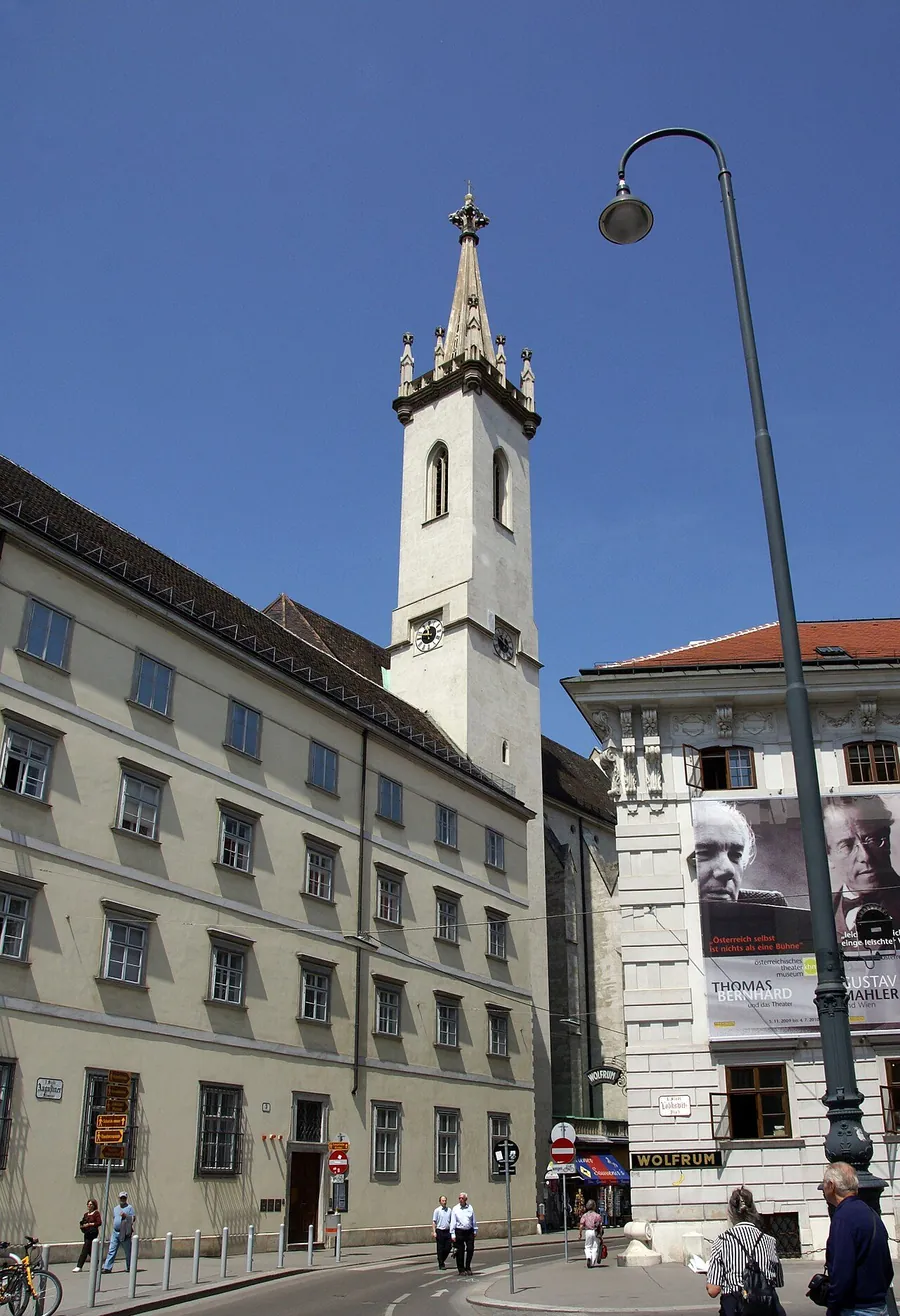
In 1327 the Habsburg Duke Frederick the Fair founded a church and monastery next to the Hofburg for the Augustinian Hermits. The Gothic nave was built between 1330 and 1339 under master builder Dietrich Landtner of Pirna, and the church was consecrated on 1 November 1349. At first the building stood on its own; only with the extension of the Hofburg and the Albertina wing did it become part of the palace.
From 1634 to 1918 the Augustinian Church was the imperial court parish church, where the Habsburgs were married: Maria Theresa and Francis Stephen of Lorraine in 1736, Marie Antoinette in 1770 by proxy to the future King Louis XVI of France, and Emperor Franz Joseph and Elisabeth of Bavaria in 1854. After Vienna became an archdiocese in 1722, newly appointed archbishops set out from here in solemn procession to St. Stephen’s Cathedral.
In 1630 Emperor Ferdinand II called the Discalced Augustinians to the church. In their heyday, around 1750 to 1780, up to 90 Augustinians lived in the monastery; the best known was the popular preacher Abraham a Sancta Clara (1644–1709), whose sermons were printed during his lifetime. In 1783 the Augustinian Church became a parish church, and in 1784/85 Joseph II had it restored to its Gothic form by the court architect Johann Ferdinand Hetzendorf von Hohenberg; 18 Baroque side altars were removed in the process.
As a result of the Josephinist reforms the monastery died out in 1836, and for 115 years diocesan priests looked after the church. In 1951 Augustinians expelled from the Sudetenland took over church and monastery again; at first they devoted themselves mainly to the parish and to the expellees, today to pastoral care in the parish and the formation of young members of the order.
For the Augustinians and the parish the church is above all a place of prayer: here people are baptised and married, the friars pray the Liturgy of the Hours, and the parish celebrates its services and the High Mass with choir and orchestra.
St. Augustine's through the ages
The Heart Crypt
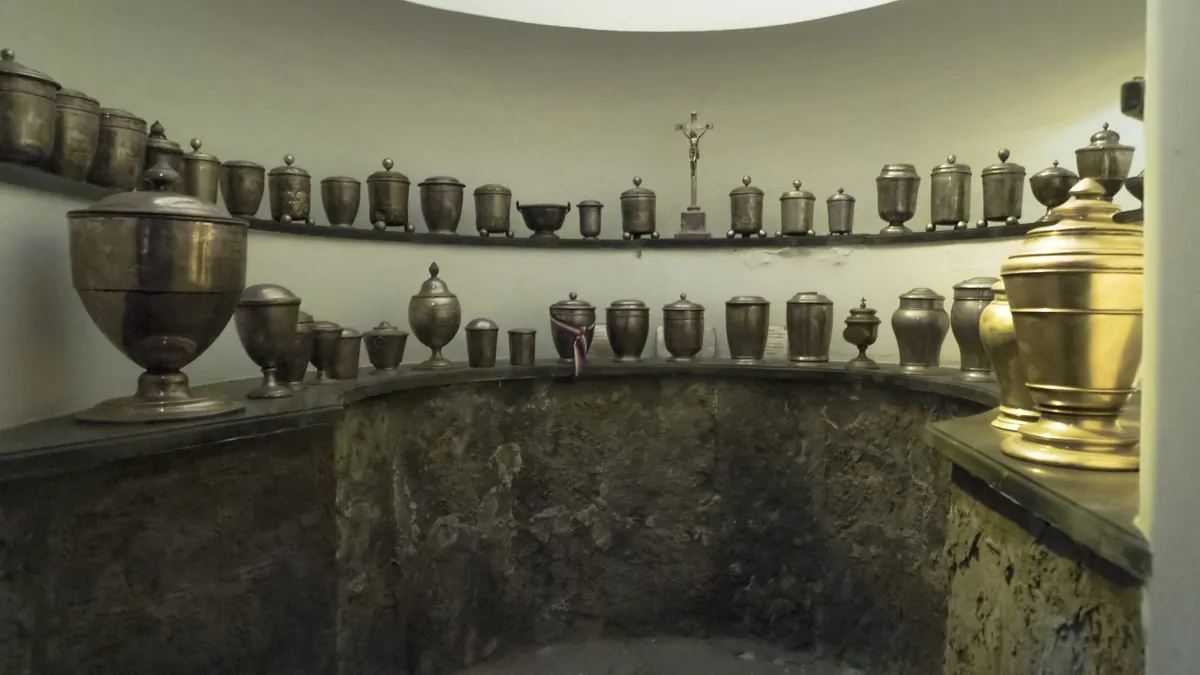
The Loreto Chapel of the Augustinian Church houses the Heart Crypt of the House of Habsburg. Between 1637 and 1878 the hearts of 54 members of the imperial family were laid to rest here in silver urns, separately from the body, which traditionally rests in the Imperial Crypt of the Capuchin Church, while the entrails were buried in the Ducal Crypt of St. Stephen’s Cathedral. This “separate burial” was a unique expression of the Habsburg culture of remembrance.
The Heart Crypt is not open to the public, but it can be visited on a booked guided tour.
Guided Tours of the Church
Explore the Augustinian Church and the Heart Crypt with an expert guide.
Group tours include the nave, the high altar and, by arrangement, the Loreto Chapel with the Heart Crypt. For school classes, the architecture, the history and the meaning of the Heart Crypt are explained in an age-appropriate way.
- Church tour
- Augustinian Church and Heart Crypt, about one hour, € 10 per person
- Heart Crypt
- about half an hour, € 5 per person
Church Guide of St. Augustine
The printed church guide (in German), published by Kunstverlag Peda in Passau with texts by Dr. Arthur Saliger, is available after the services at the church music table in the foyer and in the sacristy, and on weekdays at the parish office. On request we will send it to you: +43 (0)1 533 70 99 (Ms Lechner).
Tour of the Church
A walk through the Gothic hall church, its chapels and works of art.
The Interior
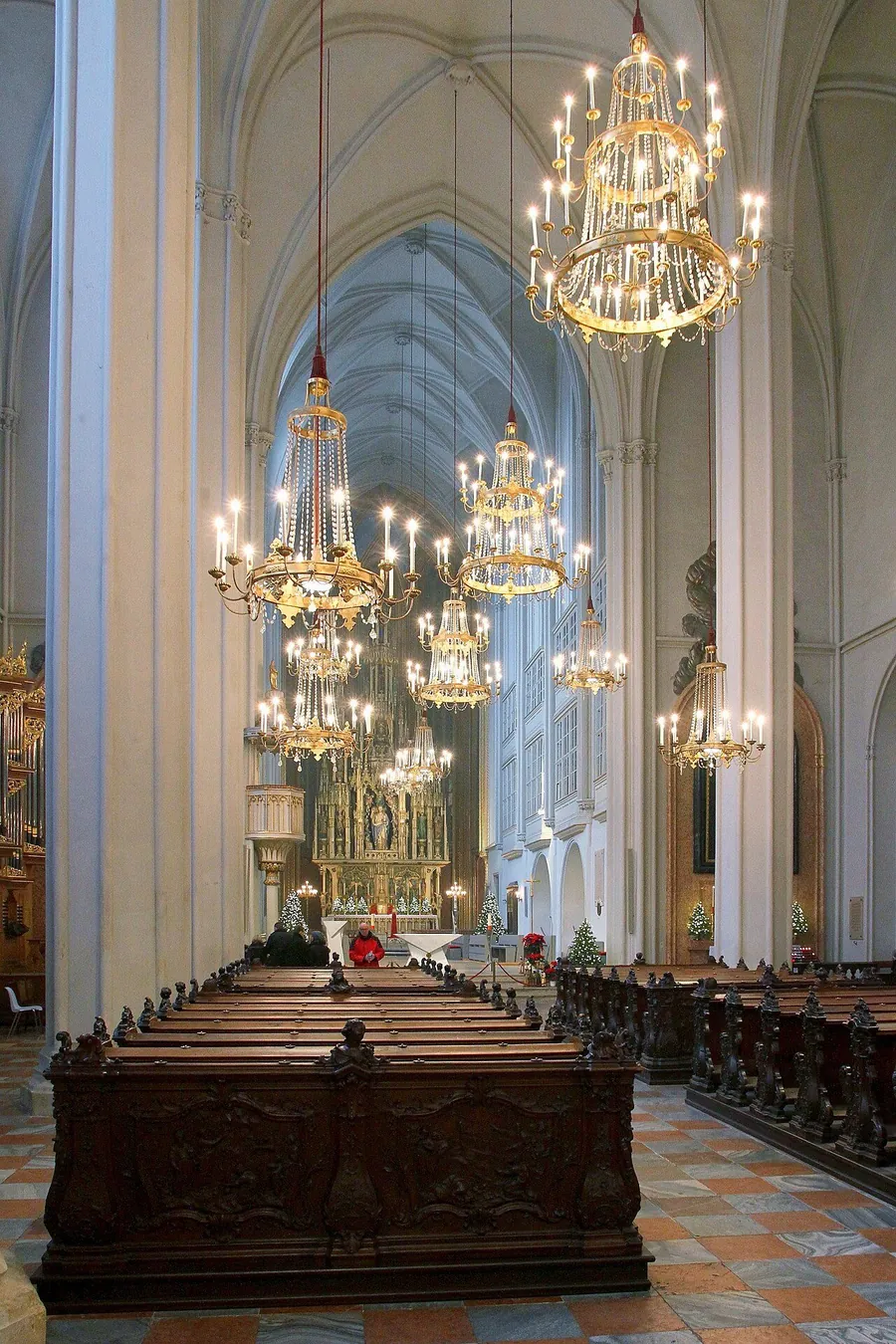
Until the city walls were demolished in 1857, the Augustinian Church was the second largest church in Vienna. The Gothic interior is an 80-metre-long hall church, 30 metres of which are taken up by the choir. The pews in the front part of the nave, with richly carved ends showing biblical scenes, were made by Johann Baptist Straub around 1730 for the Church of the Black Spaniards; under Joseph II they came to St. Augustine, like other pieces from dissolved monasteries. Pews bearing the emblem of Emperor Charles VI come from the St. Joseph’s Chapel of the Hofburg and the former Jakober convent.
Tomb of Archduchess Maria Christina
To the right of the entrance stands the masterpiece of Antonio Canova, the tomb of Archduchess Maria Christina, daughter of Maria Theresa and wife of Albert of Saxe-Teschen, created between 1798 and 1805. Figures of Virtue carrying the urn and of Charity supporting an old man walk towards a steep pyramid with a dark tomb door; a lion rests on the steps, and above, a genius holds the portrait of the archduchess. The work is regarded as a masterpiece of neoclassical funerary art and served Canova’s pupils as the model for his own tomb in the Frari church in Venice.
High Altar
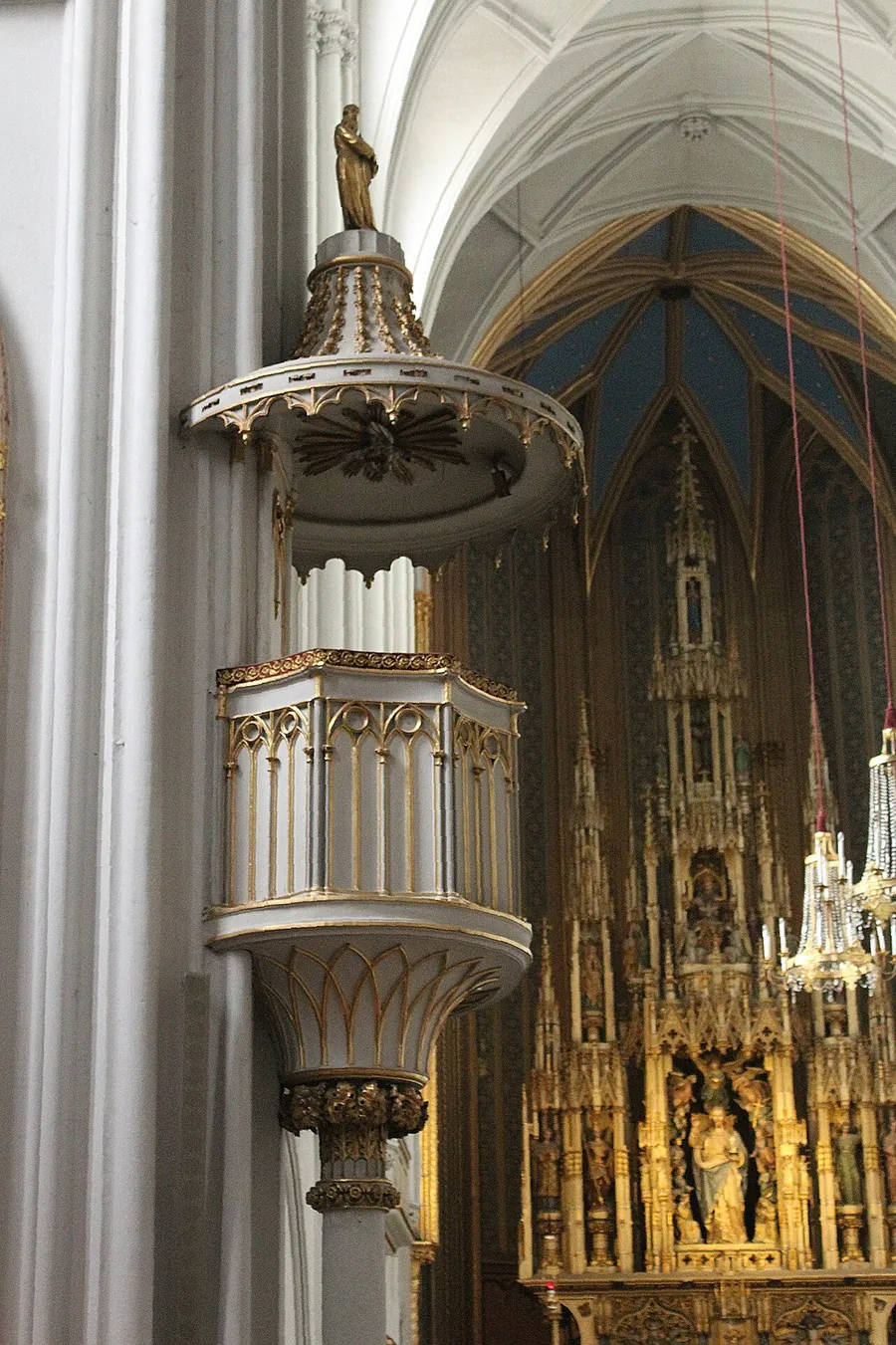
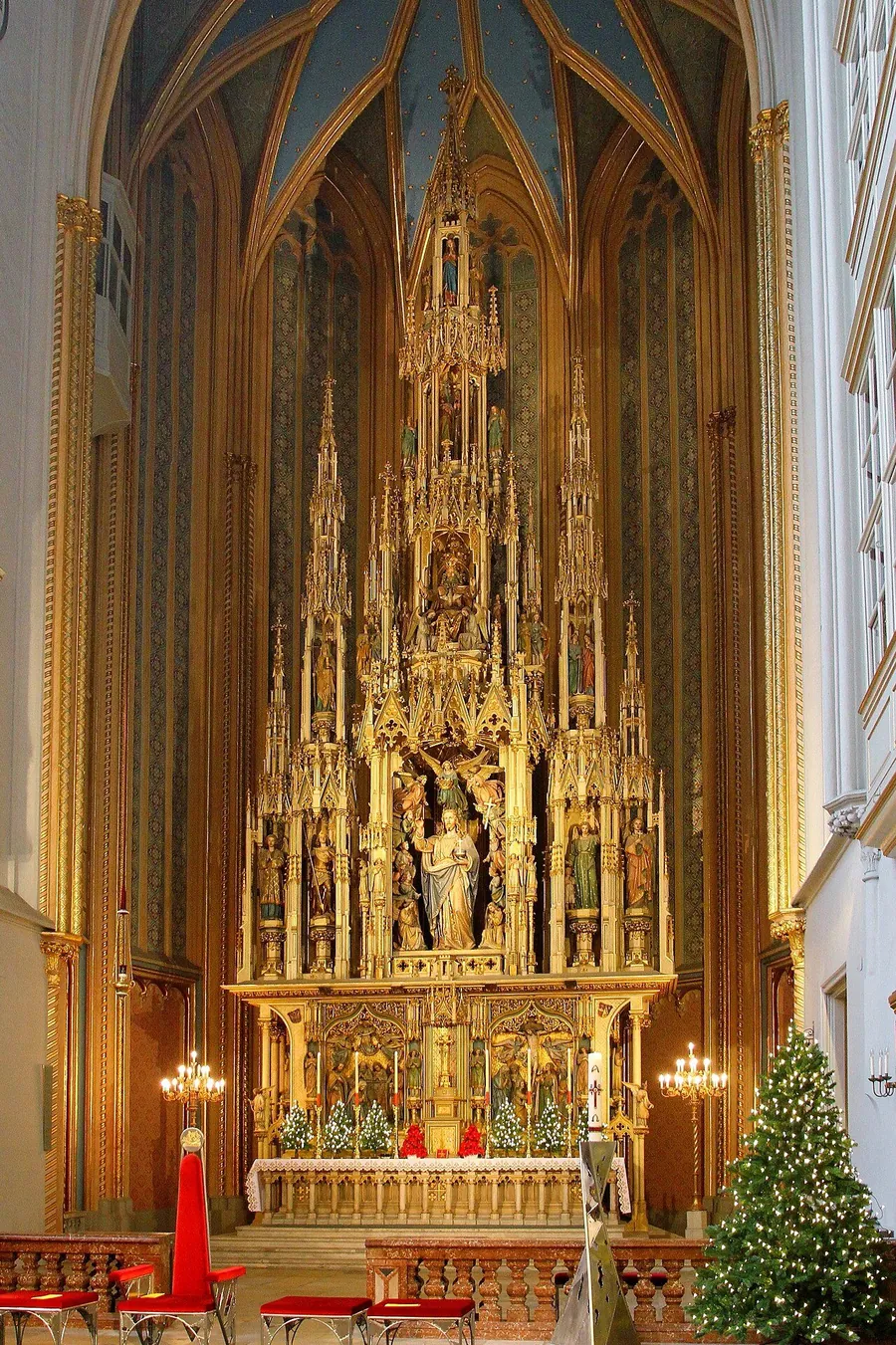
The painted stone high altar by Andreas Halbig is already the fifth in the history of the church. It was made between 1857 and 1870 in the style of the 15th century and was originally intended for the Votivkirche. The altar of Christ the King shows Christ as ruler of the world, surrounded by angels and the patron saints of Emperor Franz Joseph. During the interior restoration of 1997 to 1999 its original neo-Gothic colouring and Halbig’s paintings in the apse were restored.
Chancel
The chancel was designed in 2003 by Johannes Höfinger. Altar and ambo of white Carrara marble take up the shape of the triangle, inspired by Augustine’s work on the Trinity, “De trinitate”; the altar table also recalls an open book and Augustine’s “Tolle lege, take up and read”. The presider’s chair and the altar and Easter candlesticks are made of chrome-nickel steel, the processional cross is gilded; the seating was made by the Arnauer company in Sierndorf.
St. George’s Chapel
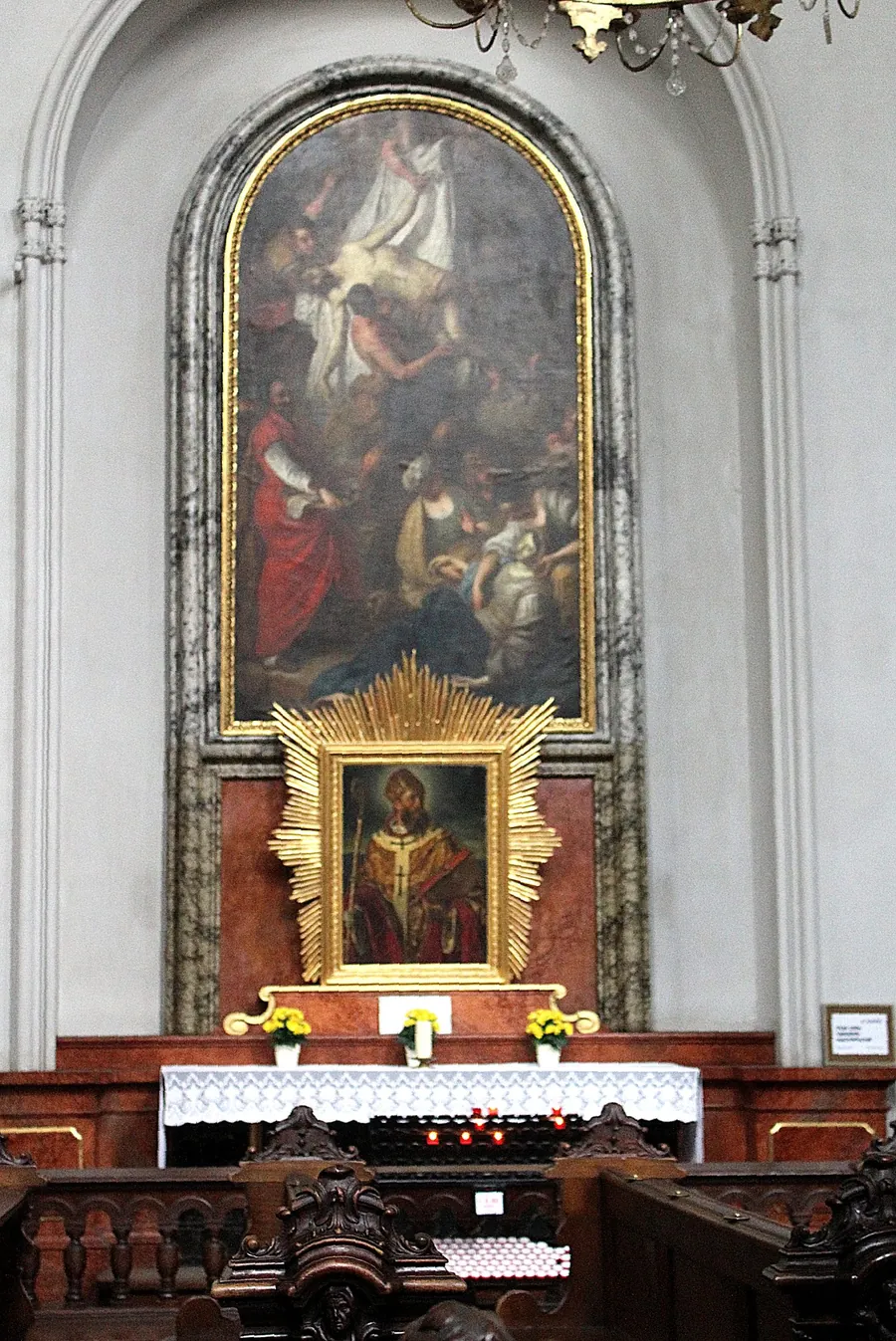
South of the choir lies the two-aisled Gothic St. George’s Chapel. It was built as the meeting room of the Order of St. George founded by Duke Otto the Merry, is mentioned in 1337 as a foundation of Ulrich von Wallsee and was consecrated in 1341. Notable are the wall tombs of Counts Wirich Daun (by Jakob Schletterer) and Leopold Daun, the victor of Kolin (by Balthasar Ferdinand Moll), and above all the cenotaph of Emperor Leopold II, created by Franz Anton Zauner in 1799. Gerard van Swieten, personal physician to Maria Theresa, is also buried in the crypt.
Loreto Chapel and Heart Crypt
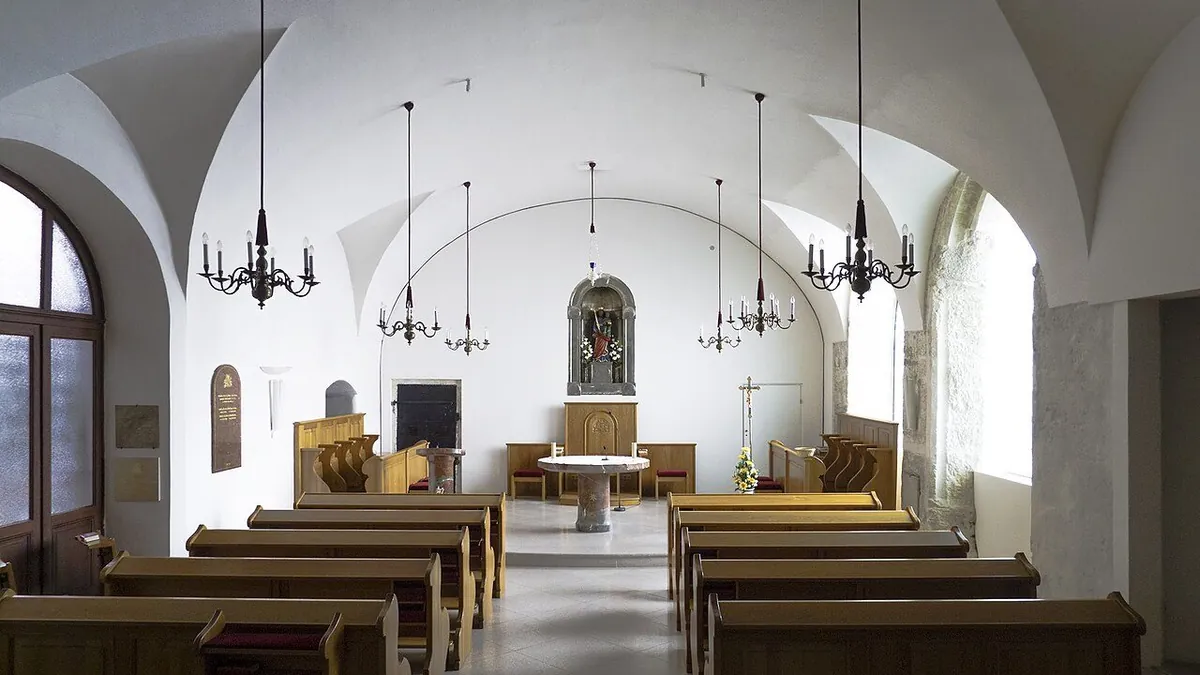
The Loreto Chapel, a replica of the Holy House of Loreto, was built in 1627 in the middle of the nave and moved in 1784 to its present location in the former Gothic chapter house. Today the friars pray here, and services are held on weekdays. From the chapel one reaches the Heart Crypt of the Habsburgs: their bodies rest in the Imperial Crypt, their entrails in St. Stephen’s Cathedral and their hearts here.
Sacristy
The sacristy is decorated with elegant courtly stucco from 1719. The richly carved cupboards of 1704 were made by the friars Cajetanus a S. Josepho and Bernardus a S. Antonio, both trained cabinetmakers.
The Organs
The church has two organs: the great Rieger organ of 1976 with 48 stops in the historic case of 1785, and the small Reil organ of 1985, the “Vienna Bach Organ”. Read more on the pages Rieger Organ and Reil Organ.
Holy Mass & High Mass
| Sunday | 11:00 | High Mass with choir, soloists & orchestra Augustinian Church |
| 18:30 | Holy Mass Augustinian Church | |
| Tuesday | 18:30 | Holy Mass Loreto Chapel |
| Thursday | 18:30 | Holy Mass Loreto Chapel |
| Saturday | 18:30 | Vigil Mass Loreto Chapel |
The Heart Crypt
In the Heart Crypt of the Augustinian Church the hearts of 54 members of the House of Habsburg rest in silver urns — a quiet and unique testimony to the centuries-old bond between the Augustinian Order and the imperial family.
Read the full storyAugustinian monastery: 1010 Vienna, Augustinerstraße 3
Tuesday & Friday: 10 am – 12 noon
and by appointment by phone